The Token Has a Smokestack
OpenAI will spend $750 billion on infrastructure; data centers are headed for a fifth of US electricity; grid prices near the buildout are up 76% in a year. The AI boom's bill is real, and pieces of it land on everyone / so here is the operator's playbook: budget at true cost, measure cost per outcome, right-size the model, and engineer like watts are scarce. Because they are.
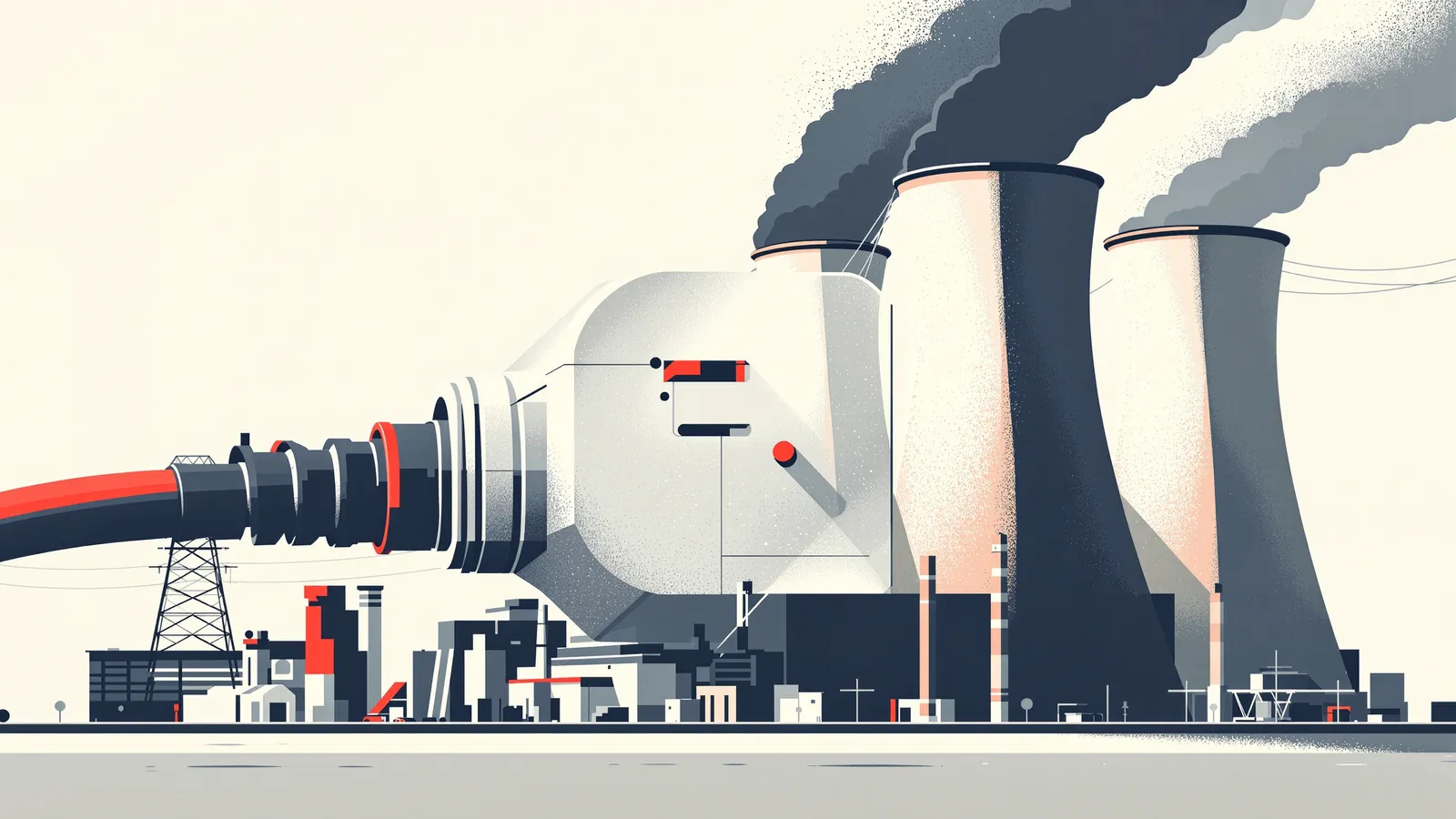
OpenAI announced this week that it will spend $750 billion on infrastructure through 2030 / a number 25% larger than the estimate it gave earlier this year, for a buildout whose flagship project has reportedly stalled. The first installment is a $20 billion, 1,400-acre data center campus northwest of Savannah, Georgia, drawing at least 3.2 gigawatts from the local utility. That is roughly three nuclear reactors' worth of demand, for one campus, for one company.
We build AI systems for a living, so read this the way we mean it: the boom is real, the capability is real, and the bill is real too. The interesting question is not whether $750 billion is a lot of money. It is who ends up paying for the electricity, and what a business that merely uses AI should do while the answer gets sorted out.
The math has stopped being abstract
Start with the demand side, because the forecasts have stopped creeping and started leaping. BloombergNEF now projects that data centers will consume one-fifth of all electricity generated in the United States by 2035 / four times today's share, on nearly 200 gigawatts of capacity, close to half of it dedicated to AI training and inference. That estimate is 83% higher than the same consultancy's own forecast from December. EPRI has more than doubled its projection. S&P raised theirs by a third in six months. When every referee keeps moving the goalposts in the same direction, believe the direction.
The strain is already priced in. On the PJM grid, which runs from Virginia to Illinois and hosts much of the country's data center fleet, electricity prices are up 76% in a year, one utility has threatened to leave the interconnection entirely, and data centers still represented 38% of the charges in the most recent capacity auction. Demand is not politely queuing behind supply. It is bidding the price up for everyone on the wire, including every business that has never bought a GPU in its life.
Who pays for Camellia
Now the supply side, because the Georgia project is a tidy case study in how these deals are structured. To OpenAI's credit, the announced terms are more honest than most: the company says it will pay the full cost of its infrastructure and electric service, Georgia's utility commission adopted a rule last year preventing utilities from passing large new users' costs onto ratepayers, and OpenAI has agreed to shed up to a gigawatt of load when the grid is stressed. Those are real guardrails, and other states should copy them.
But look at what fills in the gaps. Effingham County is handing over a 50% property tax abatement for fifteen years. Neither OpenAI nor Georgia Power will say exactly how the campus will be powered, but the utility's own regulatory filings say most of its new capacity will come from natural gas / 5.8 gigawatts of it, about a quarter from the dirtier simple-cycle turbines, more than doubling the utility's entire gas fleet. And the executive OpenAI hired to build it made his name on xAI's Colossus in Memphis, a facility built in record time that is now the subject of a lawsuit from the NAACP and the Southern Environmental Law Center alleging dozens of unpermitted gas turbines. Fast, in this industry, has a track record.
So the honest summary is: the sticker price is paid by the company, the tax base and the airshed are negotiated locally, and the grid congestion is shared by everybody. The token you generate in an app has a supply chain now, and the supply chain has a smokestack.
Why an operator should care
Here is the part that belongs on this blog rather than in the climate press. For a decade, every plan a business wrote quietly assumed compute gets cheaper forever. That assumption is now doing battle with a power market where the marginal watt is contested, and with frontier labs that need historic returns on three-quarters of a trillion dollars of infrastructure. Meanwhile frontier-caliber open-weight models are squeezing prices from below, which is good for buyers and brutal for the labs' margins / which means pricing on the models you rent will stay strange, bundled, and renegotiated for years.
You cannot control any of that. What you can control is whether your own AI usage is disciplined, measured, and pointed at outcomes. We made this argument about render pipelines and cloud bills already: the demo is cheap, the habit is expensive, and the invoice arrives with commas either way.
What to actually do
Budget AI at true cost, not at promo pricing. Whatever you pay per token today is a moment in a price war, not a law of nature. Model your unit economics at today's price and at twice today's price, and know which workflows survive both.
Measure cost per outcome, not cost per token. A cheaper model that needs three retries and a human cleanup is not cheaper. The metric that matters is what a completed, correct unit of work costs / a rendered video, a qualified lead, a closed ticket.
Right-size the model to the job. Frontier models for frontier problems. For the routine ninety percent / classification, extraction, formatting, summarization / smaller and open-weight models do the work at a fraction of the compute, and the fraction is the point.
Engineer like watts are scarce, because they are. Cache what repeats. Batch what can wait. Schedule heavy jobs off-peak. This is the same FinOps discipline we preach for render fleets, applied one layer down the stack.
Put your energy bill and your cloud bill on the same page. Literally. They are converging into one number: what it costs to run your operation on other people's electrons. If your region sits on a strained grid, that number has a trend line worth watching.
Our position
We are not rooting against the buildout. We build on this infrastructure daily and our clients get real value from it. But scale is not a strategy, and neither is awe. Somewhere between a Georgia pine flat drawing three reactors of power and a county handing back half its property taxes, the industry's costs became everyone's costs / on the grid, in the air, and eventually on your invoice.
The response is not panic and it is not abstinence. It is the most unglamorous virtue in operations: discipline. Use the machine where it earns its watts, measure what a result actually costs, and let the companies spending $750 billion worry about their own math. The token has a smokestack now. Spend it like you know that.