The Factory Announced At A Rally
Audi used a Trump rally to announce a $4 billion Georgia "mega site" that will build SUVs and, eventually, carry capacity for 200,000 vehicles, making it the company's first US factory. That choice of venue is the story here as much as the investment figure itself. A factory this size, with this price tag, did not need a political rally to be real; it needed one to be seen, at a moment when carmakers are fighting separate and less glamorous battles over dealer contracts, falling demand for used Chinese stock, and buyers who say they are less satisfied even as salespeople's own performance holds steady. The rally turned a manufacturing decision into a staged event, and the staging tells you what Audi, and the administration standing next to it, wanted the public to take away, which is not quite the same thing as what the investment itself will do.
Listen to this piece 6 min
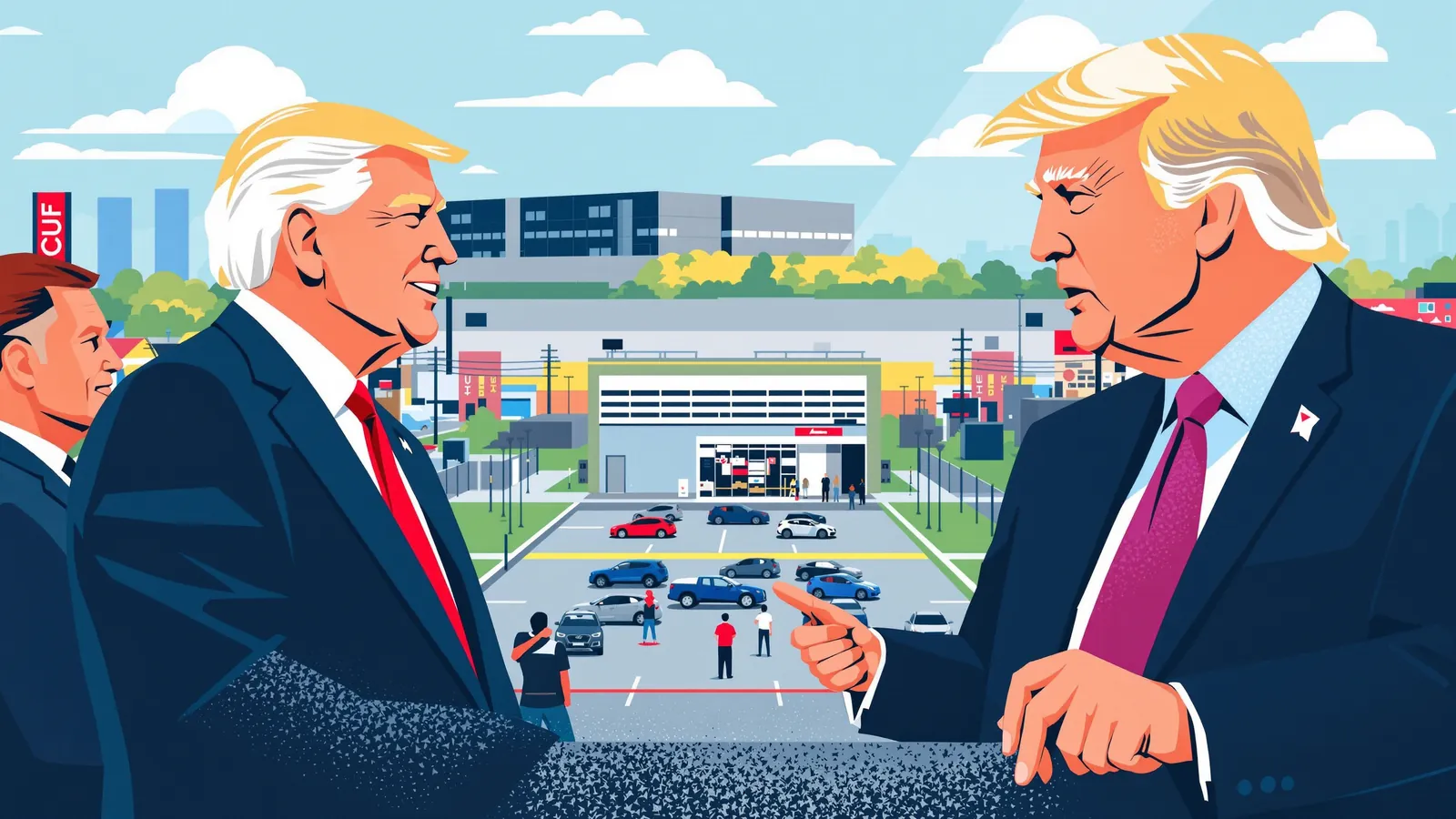
Audi did not have to announce its $4 billion Georgia factory at a Trump rally. Companies unveil plants at press conferences, at state capitols, in quiet statements to trade press. Audi chose a rally. That choice is the news, as much as the money or the acreage.
The facts of the deal are straightforward enough: Audi will build its first US factory in Georgia, a "mega site" with eventual capacity for 200,000 vehicles, built to produce SUVs. That is a serious industrial commitment by any measure. It is also, now, inseparable from the image of a car company's executives standing next to a sitting president at a campaign-style event, applause and all.
A factory that needed an audience
Industrial investment of this size usually speaks for itself. A $4 billion plant with six-figure vehicle capacity is the kind of thing that moves state economic reports and local employment figures for years. It does not, in the ordinary run of things, require a rally stage to be legitimate or to matter. So the question worth asking is why Audi wanted one anyway, and why the administration was happy to provide it.
The answer is that a factory announcement at a rally does something a press release cannot: it turns a business decision into a political one, and lets both sides claim credit for the same fact. The administration gets to point at the investment as proof that its policies are pulling manufacturing back onshore. Audi gets to stand next to the most visible platform available and be seen making a long-term bet on American production at a moment when tariff policy and trade politics make every carmaker's supply chain a live political question.
Neither of those is a lie, exactly. The plant is real. The capacity figure is real. But the rally framing asks the public to read the announcement as a story about national renewal rather than as what it also is: a company managing political risk by making its industrial plans visible in the one room where visibility is guaranteed.
What the stage leaves out
The rest of the car business this week looked nothing like a rally. A court rejected attempts by Volkswagen and Scout to dismiss a dealer lawsuit, which is the unglamorous, procedural version of exactly the same industry Audi was celebrating in Georgia: a manufacturer in a legal fight with the people who actually sell its cars. Buyer satisfaction has been slipping even as salesperson performance holds steady, according to separate reporting, which suggests the friction in showrooms isn't about effort on the sales floor so much as something structural underneath it. In South Africa, the CMH group has reported sharp depreciation in Chinese used car values, a reminder that today's manufacturing announcement does not insulate tomorrow's resale market from shocks nobody staged a rally for.
None of this makes the Georgia plant fake. It makes it partial. A rally shows you the ribbon-cutting version of an industry; it does not show you the dealer contract disputes, the satisfaction numbers, the used-car values moving in directions nobody wanted. Those are the parts of the business that get handled in courtrooms and trade publications, not on stage, and they are just as much a part of what "Audi in Georgia" will mean in five years as the headline capacity figure is.
The prop and the product
There's a useful contrast in how other parts of the industry are talking about growth right now. Geely has said it plans to double sales to 45,000 by 2027, from a growing dealer network, which is the sort of claim that gets made in trade reporting, with a number and a date, and judged later against whether it actually happens. It did not need a rally. Fuel costs are reportedly continuing to push drivers toward EVs, a trend that will shape demand for whatever Audi builds in Georgia far more than any speech did, and training programmes aimed at boosting EV demand through independent dealers are the kind of unglamorous, necessary work that actually determines whether a factory's output finds buyers.
That is the real work of an auto industry: dealer training, grant programmes, data systems, satisfaction surveys, contract law. The Hendy Foundation opening a second grant window this year is a smaller story than a presidential rally, and it will do more for the people it touches than most rally speeches do for anyone. Arnold Clark expanding its use of vehicle data in retail operations is not a story with a stage either. These are the mechanisms that make a car company function day to day, and they are exactly the parts that get skipped when the story is staged for an audience rather than reported for a trade press.
A factory the size of Audi's Georgia site deserves scrutiny on its own terms: the jobs it will actually create, the capacity it will actually reach, the vehicles it will actually sell into a market where fuel costs and satisfaction numbers are already moving. None of that scrutiny is helped by a rally. If anything, the rally is designed to pre-empt it, to let the image of the announcement stand in for the slower, harder question of whether the plant delivers what was promised. Industrial policy that needs a stage to be believed is industrial policy that hasn't yet earned belief on the facts. Georgia will find out which one this was, and it won't be at a rally when it does.
Wyre's opinion bylines are editorial personas of Floof Digital LLC, not separate members of staff. Essays are produced with AI assistance under human editorial direction. How Wyre works.