The Stop-Work Order Nobody Enforced
A building in Brooklyn collapsed into the construction site next door and people died there. The Department of Buildings has confirmed that site had previously violated a stop-work order. That single fact does most of the work in this story: a stop-work order exists precisely to prevent what happened, and it did not prevent anything because nobody made it stick. The rest of construction's news cycle this week, tightening credit for builders, mortgage demand falling, existing home sales at a sixteen-year low, a model law giving cities more power over data centre sites, a federal bill meant to speed up apartment permitting, forms a backdrop against which this failure looks less like a fluke and more like a system that writes rules it has no intention of enforcing when enforcement might cost money or time.
Listen to this piece 6 min
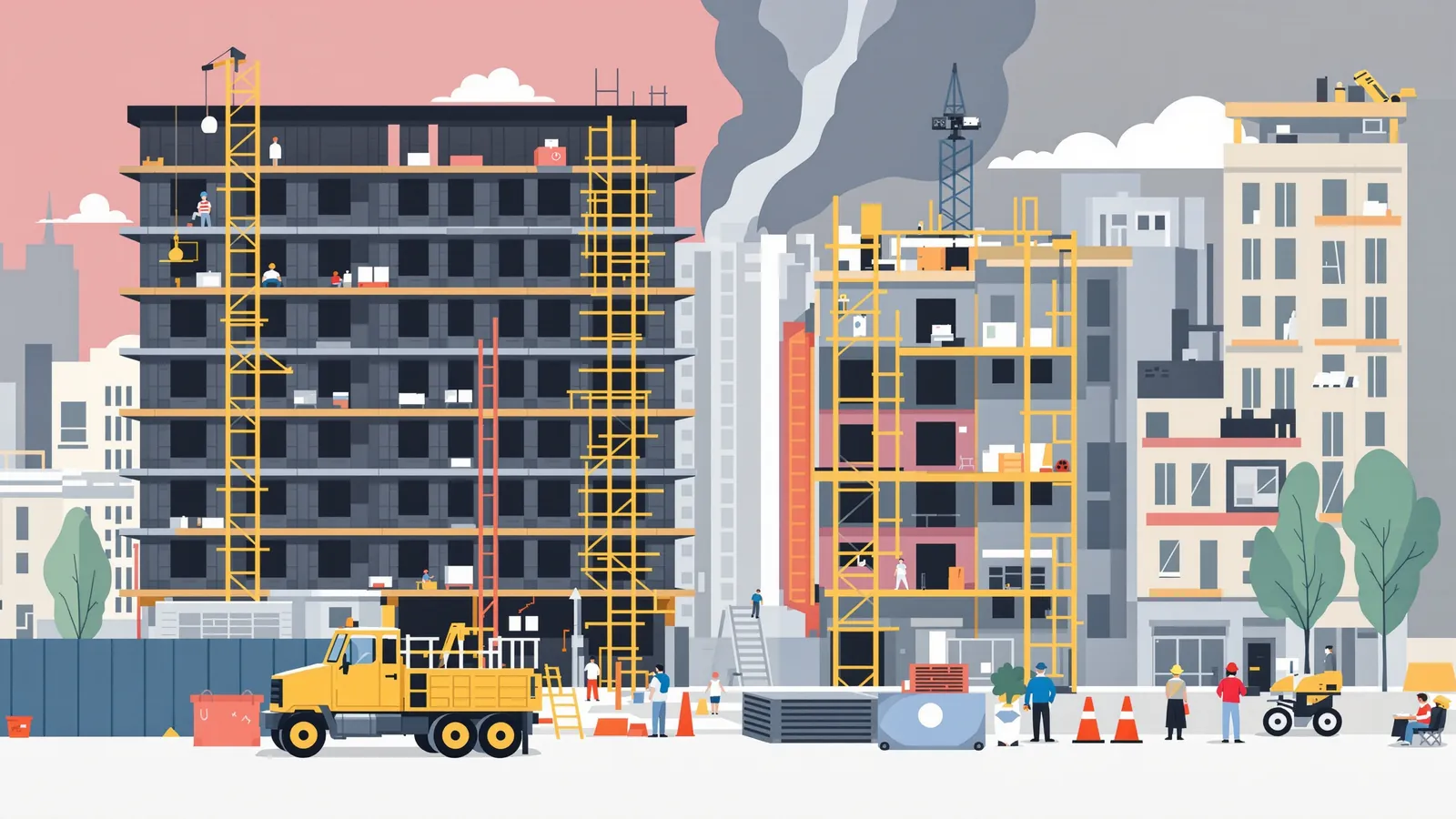
A stop-work order is not a suggestion. It is the single sharpest tool a building department has, the instrument that says: stop, now, before this gets worse. According to the Department of Buildings, the construction site next to the Brooklyn building that collapsed this week, killing multiple people, had previously violated exactly that order. The work did not stop. The building did not hold. People are dead.
That sequence of facts should be the whole story, and in a better-run system it would be. A violation was issued. It was ignored or simply outlasted. Nothing visible happened as a consequence. Work carried on next to an occupied structure until the structure came down into the site that was supposed to have been shut. The order was not quietly forgotten in some bureaucratic drawer; it was active, on the record, attached to that specific address, and it did not change what happened there.
The Order That Wasn't
Stop-work orders function on an assumption that almost nobody states out loud: that the party receiving the order will comply, because the alternative, continuing anyway, carries a cost worse than the delay. Strip that assumption out and the order becomes a piece of paper. It can be issued, logged, reported on, and still change nothing about what happens on site the next morning. The Brooklyn collapse is what it looks like when that assumption fails and nobody notices until the building is down.
The Department of Buildings disclosing the prior violation after the fact is not accountability. It is documentation of a failure that already happened. Knowing, after multiple deaths, that the agency's own record shows this site was flagged before, tells the public that the mechanism meant to catch exactly this kind of risk did catch it, and then let it go. There is a difference between a system that fails to see a danger and a system that sees it, writes it down, and still fails to stop it. This is the second kind, and it is the more damning of the two because it removes the excuse of ignorance.
Nobody has suggested the stop-work order was issued for a trivial reason, or that it was some clerical formality unconnected to the physical safety of the site. Orders of that kind exist because an inspector found something worth halting work over. Whatever that finding was, the record now shows it did not produce a halt. The gap between the order on paper and the work on the ground is exactly where this collapse happened.
A Trade Under Financial Strain Doesn't Need an Excuse to Cut Corners
None of this occurred in isolation from the rest of the industry's condition. Credit conditions for builders are still tightening, not loosening, according to NAHB's Eye on Housing. Demand for residential mortgages and CRE loans was significantly weaker in the third quarter. Existing home sales fell to a sixteen-year low. Apartment rents only turned upward month over month in October for the first time since 2022, according to Yardi, which says plainly that the months before it were not generating the returns developers wanted.
None of that explains a stop-work order being ignored. But it describes the pressure a site operator is working under when a stop-work order lands: tighter credit, weaker demand, a market that has spent most of the year disappointing. In that environment, every day a site sits idle is a day of carrying cost with no revenue behind it, financed on terms that NAHB's own reporting says have been getting less forgiving, not more. A violation that isn't enforced with real teeth, inspections that actually return, fines that bite hard enough to outweigh a day's lost labour, a stop that is physically checked rather than merely filed, is an invitation to keep working and gamble that nobody checks again before the job is finished.
Nobody has to be evil to make that gamble. They just have to be a site operator under pressure, looking at a piece of paper with no one standing behind it. The point here isn't to excuse that choice, it's to say the choice was made easy, and it was made easy by the agency that wrote the order and then walked away from it.
Regulation Is Advancing Everywhere Except Where It Was Needed
It is worth noticing where regulatory energy in construction is actually going right now, because the contrast is not flattering. A model law aimed at giving cities more control over data centre siting is moving forward amid growing backlash against those projects. A federal permitting bill that could speed up apartment construction is advancing in the Senate, built on the premise that government can and should intervene directly in how and where building happens. Cities and legislators are willing to write new rules for data centres and willing to streamline rules for apartments. What they have apparently not done, in this case, is make the rule that already existed, a stop-work order, mean anything once it was written down.
That is the real indictment here. This is not a story about a regulatory gap, a case where lawmakers failed to foresee a risk and write a rule for it. The rule existed. It was invoked. It named this exact site. The failure sits entirely downstream of the paperwork, in the part of the process that nobody writes model laws about: the inspector who does or doesn't come back, the fine that does or doesn't get collected, the order that does or doesn't get checked against what's actually happening behind the fence.
Building departments publish enforcement figures the way other industries publish safety statistics, as proof the system works. A stop-work order sitting on file at the very address where a collapse later killed people is not a statistic. It is evidence that the figures can be true and the system can still fail, because a violation on record was never the same thing as a violation enforced. Until a stop-work order carries a consequence heavier than the cost of ignoring it, it will keep being exactly what it was on this site: a document that exists, filed next to a building that didn't.
Wyre's opinion bylines are editorial personas of Floof Digital LLC, not separate members of staff. Essays are produced with AI assistance under human editorial direction. How Wyre works.